BASE welcomes the publication of Alan Milburn’s final report, From a Welfare State to a Working State, and its ambition that every young person should be earning or learning. Young people want to work, build careers and support their communities. As the report recognises, what holds them back is not a lack of motivation or aspiration, but systems, opportunities and support that too often fail them.
Disabled and neurodivergent young people face particular barriers. In 2025/26, disabled young people aged 16 to 24 were more than three times as likely to be NEET as their non-disabled peers (30.2% compared with 8.6%), and nearly half of all NEET young people (45.3%) are now disabled (DWP, The employment of disabled people 2026).
We particularly welcome the shift from what a young person cannot do to what they need to build a future. This is the starting point of supported employment. To make it real, assistance should be built on the supported employment model: the right job, for the right person, with the right support.
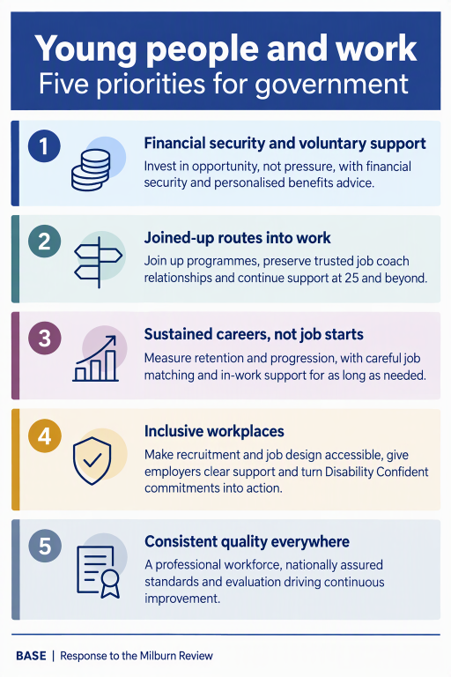
Financial security and voluntary support
We welcome the principle that support comes first. Young people engage when they trust the support on offer and feel financially secure enough to try work. Pressure to accept offers that do not match a young person’s aspirations may raise job entries in the short term, but those jobs are less likely to last. Repeated setbacks can push young people further from work. Our focus should be on investing in opportunity and success alongside financial security and personalised benefits advice
Joined-up routes into work.
We welcome a single front door, one named adviser and one plan. Linking up must also happen behind the front door, so that programmes stop working in silos and trusted relationships with a job coach continue when a young person moves between them. A point of contact is not the same as a skilled supported employment professional: there is no light-touch supported employment, and it is not another CV-building exercise. Joined-up support should also continue at 25 and beyond, so we are not simply pushing the problem up in age.
Sustained careers, not job starts.
Success should be measured by retention and progression. When supported employment is delivered well, with careful job matching and employers engaged from the start, in-work support often fades naturally as confidence grows. Some young people will need it for longer, and support should be there when they do.
Inclusive workplaces.
Supported employment shows that disabled young people thrive in ordinary workplaces when the right support is in place. Like a ramp at the entrance, accessible recruitment and job design benefit everyone. Government can help employers through clear guidance and one employer-facing route to support, with Disability Confident reform that turns commitments into action. Investment should help ordinary workplaces include everyone, rather than creating separate ones.
Consistent quality everywhere.
We welcome local flexibility. Young people should receive high-quality supported employment wherever they live, delivered by a professional workforce of job coaches and employment specialists and backed by nationally assured standards, with evaluation driving continuous improvement.
We look forward to working with Government to make this a reality for every young person.
Further Resources
Easy Read Summary of Milburn Review