BASE welcomes the Expert Panel’s report and the Government’s response.
We share the Panel’s aim of employment support that is needs-led, not diagnosis-led, and that is built on evidence. We also note the strong alignment with the Independent review into prevalence and support for mental health conditions, ADHD and autism, which reinforces the need for support to be matched to functional need, participation and quality of life, rather than relying on diagnosis alone.
We have determined four areas where we believe quality, fidelity and evidence will determine whether these commitments improve neurodiverse people’s employment outcomes, wellbeing and career progression.
1. Support should follow need, delivered by skilled practitioners
- We strongly support the Panel’s finding that focusing on “what someone needs” rather than “what condition they have” avoids tick-list adjustments that don’t fit the person, the task or the workplace. This is also reflected in the Independent review into prevalence and support for mental health conditions, ADHD and autism, which argues for support based on functional need and appropriate adjustments, not diagnosis alone.
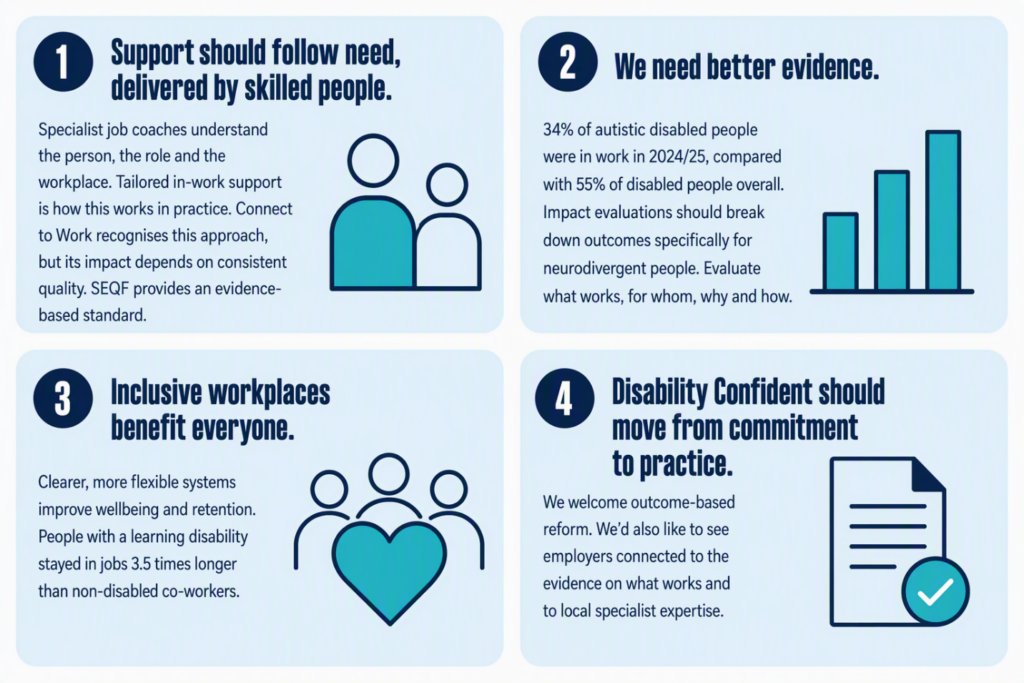
- Tailored in-work support delivered by specialist job coaches is how this works in practice. There is abundant research and evidence showing that when done well, the coach’s role fades quickly as natural supports take over. The review’s focus on appropriate support and reasonable adjustments links directly to BASE’s case for specialist job coaches who understand the person, the role and the workplace.
- We welcome the Government’s recognition of tailored support in Connect to Work. Its impact depends on model fidelity and quality assurance, so that people get the same quality of support wherever they live. The Independent review into prevalence and support for mental health conditions, ADHD and autism reinforces this point: policy commitments only matter if delivery is consistent, high quality and capable of meeting real-world need. The Supported Employment Quality Framework (SEQF) and its five stages offer a ready-made evidence-based standard.
2. Invest in evidence: what works, for whom, why and how
- The Government’s announcements (Access to Work backlog, WorkWell, Pathways to Work advisers and the £60m Innovation Fund) are significant.
- We recommend that all funded programmes include robust impact evaluation that disaggregates outcomes for neurodivergent people, in as much detail as possible.
- We fully back the Panel’s nine research priorities, especially longitudinal outcomes, intersectionality and economic analysis. The Independent review into prevalence and support for mental health conditions, ADHD and autism also supports a broader evidence base that captures participation, functioning and quality of life, not only service activity, referrals or job starts.
- Official data is a gap. Only 34% of autistic disabled people were in work in 2024/25, compared with 55% of disabled people overall, yet government statistics are lacking. The issue is not only that current data captures limited detail on this area, but also that relevant experiences are often not recorded separately, or are grouped under broader categories. Better disaggregated data on neurodivergence, learning disabilities and other disabilities in relation to work and employment is essential to understand what works, for whom, why and how.
3. Universal Design and assistive technology
- We welcome the Panel’s promotion of Universal Design. Clearer, more flexible systems benefit all staff. The Independent review into prevalence and support for mental health conditions, ADHD and autism strengthens this environmental-fit framing: improving outcomes requires changes to workplaces and systems, not just pressure on individuals to adapt.
- As an organisation that promotes the Supported Employment model, certifies providers through the Supported Employment Quality Framework (SEQF), and delivers training for providers and employers working with disabled people, BASE knows from practice that inclusive workplaces are not simply a matter of compliance. When employers create clearer, more flexible and better-supported working environments, this can improve worker wellbeing, retention and productivity for everyone, including disabled and neurodivergent workers.
- This is also reflected in the evidence. Supported Employment approaches that centre tailored, in-work support show clear benefits for employers as well as employees: people with a learning disability stayed in their jobs 3.5 times longer than non-disabled co-workers [1]; had no whole-day absences compared with 1 to 6 days among matched coworkers[2]; demonstrated similar or often better job performance[3]; and workplaces employing more disabled people reported lower accident rates[4].
- Specialist professionals, including job coaches, are central to making this happen in practice. They work alongside employers to understand the person, the job role and the workplace, identify practical adjustments, build natural supports and help inclusive practices become part of everyday working culture rather than one-off accommodations.
- Assistive technology (ATech) can strengthen this wider approach when it is integrated thoughtfully and with the right support. It should not be treated as a standalone solution, but as part of a Supported Employment model that combines individualised support, workplace adjustments and system-level change. BASE is currently evaluating ATech pilots to understand how better integration of assistive technology within supported employment can improve job outcomes, workplace inclusion and worker wellbeing.
- The review also strengthens the case for seeing good work as part of wellbeing, connection and participation when the right support is in place. This is particularly relevant to young people moving into adulthood, including those with SEND, care experience and those at risk of becoming NEET, where early supported employment pathways can help prevent exclusion from work becoming entrenched.
4. Disability Confident
- We welcome reforms to Disability Confident so that it is based on employment outcomes, with time limits on remaining at Level 1. As an adviser to the scheme, BASE believes Disability Confident should also help employers act as equal partners by connecting them to the evidence base on what works for neurodivergent people, the specialist support available, and local expertise rooted in communities. This would help the scheme join up with wider government policy and make it easier for employers to move from commitment to effective practice.
BASE would welcome the opportunity to discuss any of these points further.
Links
Expert Academic Panel on Neurodiversity’s Report and Recommendations
Easy Read – neurodiversity and work
Easy Read – government response
The Independent review into prevalence and support for mental health conditions, ADHD and autism
[1] Mencap (2017). Good for business. The benefits of employing people with a learning disability
[2] Mencap (2017). Good for business. The benefits of employing people with a learning disability.
[3] Fredeen, K. J., Martin, K., Birch, G., & Wafer, M. (2013). Rethinking disability in the private sector. Panel on labour market opportunities for persons with disabilities, 28.
[4] Fredeen, K. J., Martin, K., Birch, G., & Wafer, M. (2013). Rethinking disability in the private sector. Panel on labour market opportunities for persons with disabilities, 28.